
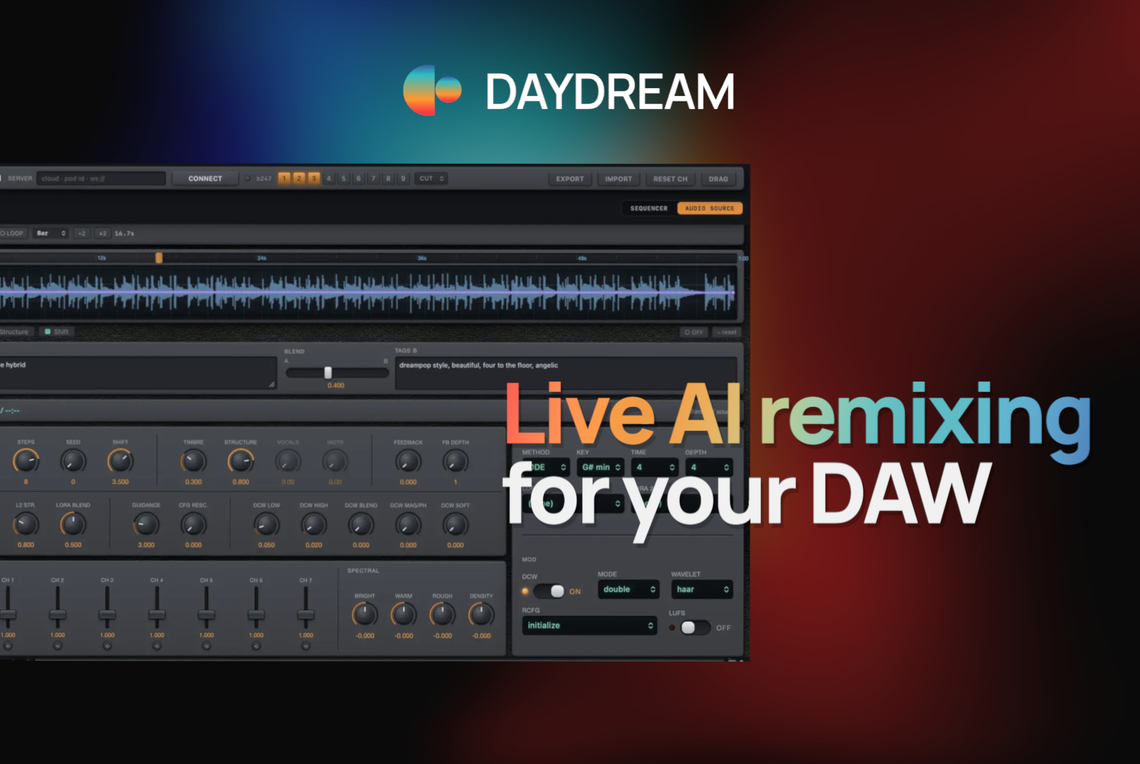
In recent weeks, Daydream has released a suite of music tooling. We sat down with our Head of Product (Hunter Hillman) to learn more about the new offerings and hear what's next for Daydream.
If you'd like to check out the latest and greatest, please see our updated Downloads, Learn, and Roadmap.
Questions, feedback, press - get in touch with us at hello@daydream.live or via Discord.
 Daydream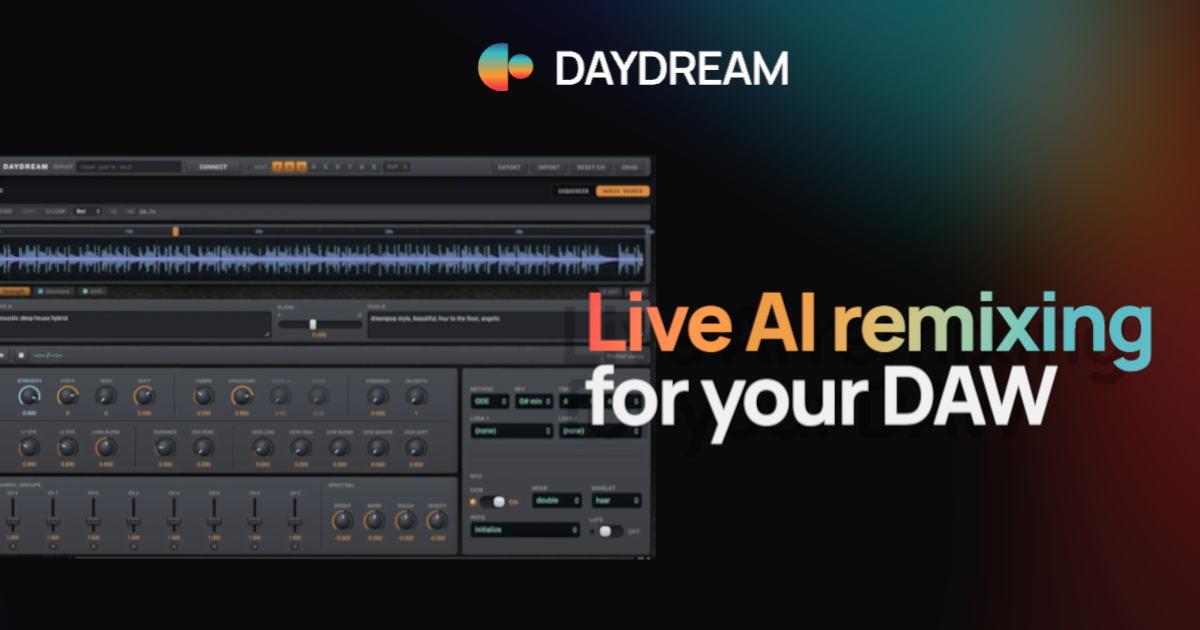
1. Daydream started in video. What happened?
Real-time generative video was very exciting to us and we’re really proud of the technical work we did in that area. After about a year of work, we came to the conclusion that neither the foundation models nor the market were quite developed enough for us to achieve the outcomes we needed.
Around that time, our technical lead presented us with some research on audio generation that not only produced great, production-quality sound in real-time, but actually outperformed Google’s Magenta model on latency by a pretty wide margin. We felt that this was not only fertile technological ground, but also a strong fit for our team’s skillset and interests. Most of us are recovering musicians and this was a market opportunity we couldn’t pass up.
2. Why is now the right moment for this?
There’s been a real backlash against a lot of the AI music tools out there. We stand with artists, full stop. But regardless of the outcome of pending litigation, AI audio generation is not going anywhere. So while artists must be fairly compensated for their work and have the right to prevent it from being used in training, we can’t put the horse back in the barn. What we can do is work together to steer the technology in a direction that is positive for artists and preserves the craft (and the joy) of making music.
3. There are a lot of prompt-to-song generators. How does Daydream compare to them?
Daydream relies on a totally distinct philosophy from Suno and Udio, and the form of our products is quite different. With those song generators, you can produce a lot of high-quality output very quickly, but something about it impinges on the creative process. It doesn’t feel like making music. Daydream remixes and generates audio in real-time and allows you to control the nuances of that generation directly in your DAW. You can even hook up a MIDI controller, which I highly recommend. We’ve heard people compare the experience to using a synthesizer, which is a really exciting idea.
4. There's a lot of anxiety in the music community about AI right now. How do you think about Daydream's relationship with artists, not just as users but as the people most affected by this technology?
We try really hard to prioritize artists in everything we do.
First and foremost, we give artists full ownership of what they make. US courts have ruled that works created solely by AI can't be copyrighted — and Suno uses that as justification to deny artists any copyright claim on what they produce with the tool. We don't think that's right or fair. It's a pattern the music industry knows well — new technology arrives, and somehow the artist ends up with less.
The reason Daydream can do things differently comes down to how the tool works. Because you're making real creative decisions throughout the process, the output reflects your authorship. You already hold the copyright. We're not granting it to you — the law recognizes it because you earned it.
Secondly, we rely on open source, ethically trained foundation models. This hurts our out-of-the-box sound quality a little bit - because royalty-free and synthetic libraries simply aren’t as rich - but it also gives us an amazing opportunity to work directly with artists to train personalized styles that preserve their unique tone and perspective.
Whether we like it or not - and I’ve certainly got mixed feelings - AI is going to become a permanent part of audio workflows. The best we can do is create pathways for people to be creative and promote the craft of music - and that starts by putting control in the hands of artists rather than models.
5. Who is this for, specifically? If you had to describe the person who's going to get the most out of Daydream, who are they?
There are many different ways to make music with Daydream, but we’ve seen a few clusters of similar usage patterns. There are producers doing sample and loop production; there are artists reimagining old tracks; there are DJs experimenting with longer sets.
In terms of style, the current audience skews a little bit towards electronic, house, EDM - but we’re also seeing a lot of interest in sound design and I suspect that other genres are going to become much more prevalent as we work with artists to develop style packs targeted at specific instruments and genres.
6. What does someone's first session with Daydream actually look like? Walk me through it.
We’ve got a few options available now - DreamMachine (an Effect VST), DreamSampler (an Instrument VST), and DreamMax (a Max for Live device).
In a first session, a typical artist gets Daydream running in their preferred DAW. They might try one of our sample tracks, but almost immediately they’ll start uploading their own tracks or beats. There’s real skill involved, so a lot of the first session is about twiddling knobs and seeing how the output instantly changes. Pretty soon, though, they’ll hear something unique or surprising - and that’s when it really clicks and they start recording.
There are so many ways to make music, and it really branches out from there. Our learning resources are a great way for folks to get started.
7. Let’s look ahead to the future of Daydream. What milestone would make you say “we did it”?
Wow, what a question. I’ll give you two. An artist I really admire is Ed Sheeran - if you’re not familiar with his process, for a very long time he performed with just himself, a guitar, and a loop pedal. So I’d love to see a solo performer - using only Daydream and their voice - sell out Red Rocks.
Second, I’m enchanted by the idea of scoring films with Daydream. I think there’s some really cool potential and I’ll aim for the stars - I want to see someone win an Oscar for Best Original Score with a soundtrack they created primarily with Daydream.